Ferrets, Robots and a Revolutionary Approach to Learning
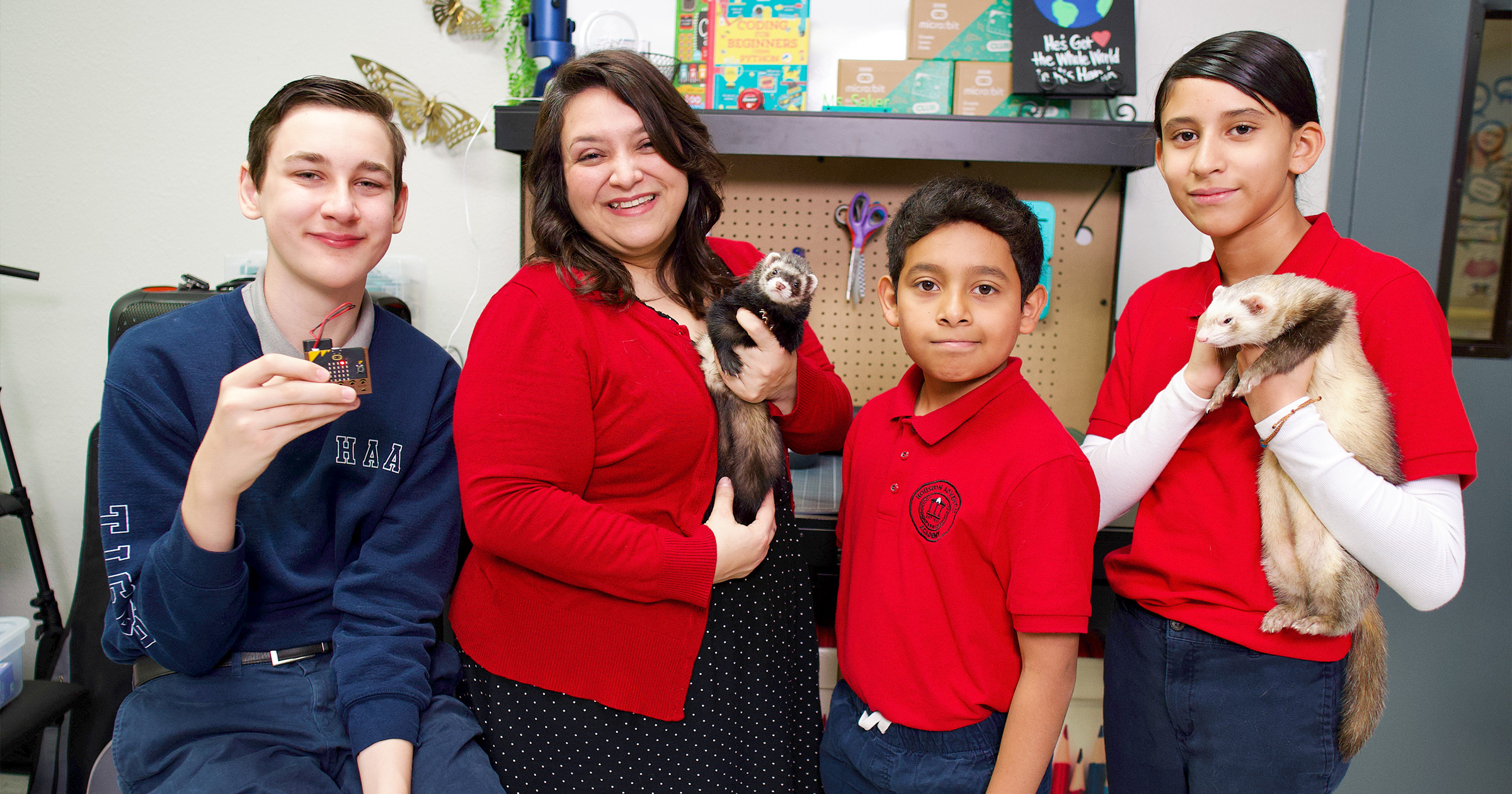
Working with pet ferrets might be the perfect way to teach students real-world problem solving. That’s exactly what Michelle Saker’s fifth and sixth-grade students at Houston Adventist Academy (HAA) are doing with the school’s new Innovation Lab, where students are working on prototypes for pet products.
“They’re loving it,” Saker said. “I love it, too, because I’m hoping they’ll solve some of my real-life problems as a pet owner!”
Saker’s students interviewed her about her pets, Jasmine and Gordo, and the challenges that come with owning ferrets. After researching best practices for ferret health, they based their project designs on the information they collected.
“We learned through our research that ferrets have to exercise to be healthy,” shared Eli Ramirez, a sixth grader. Eli and his classmates set about finding a way for people to provide exercise opportunities for their ferrets without the risk of exposing them to outside germs and predators.
“My partner and I made a maze out of cardboard so they could have a bit of exercise inside,” Eli explained. Once they had an initial design, they used Innovation Lab tools to build their prototype, which they then tested with Jasmine and Gordo. Saker’s students have plans to submit their design concepts to pet companies for production consideration once they’ve thoroughly tested and revised them.
Innovation Inspires Learning
The Innovation Lab was inspired by a conference Saker attended at Loma Linda University called EXSEED.
Motivated by this conference, Saker and another Texas teacher developed a curriculum integrating North American Division standards for education, Texas standards for STREAMS (science, technology, religion, engineering, art, math and service), and the Design Thinking model for teaching (see page 13). The curriculum they built is also adaptable for multigrade classrooms at smaller schools. Saker used this curriculum as the basis for her application for an EXSEED grant, and in October, HAA learned they had been selected as a grant recipient.
“With this grant, we’re really trying to dig deep into the original educational blueprints from Ellen G. White of how what we know as ‘redemptive education’ should be,” commented Saker. “It’s what makes Adventist education unique: training students not just in innovative technology, but teaching them how to use that technology to live a life of service.”
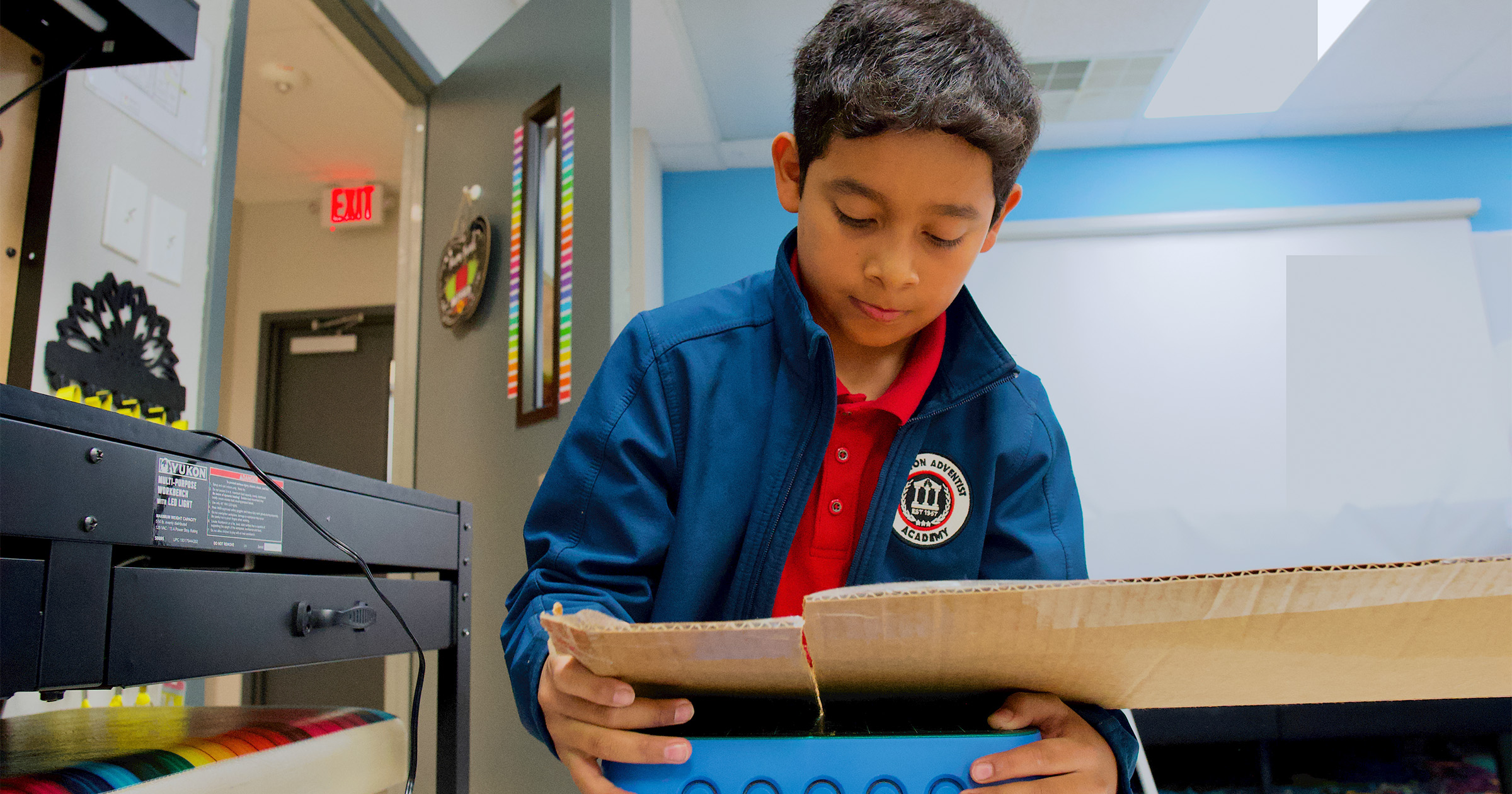
It was out of this principle that HAA’s Innovation Lab arose, beginning a transformation at the school even before they received the full grant funding and bringing a new level of excitement to the campus. Parents donated microbits (mini programmable computers), and Saker purchased a child-safe chomp saw. Then, students got to work on their first project.
Saker has seen several light-bulb moments with her students that may not have ever happened without the Innovation Lab. One student who typically struggles with math was working on a project and came to Saker for help with some calculations. “I pointed out that it was just measurement conversions—which we had just learned in math two weeks prior,” Saker said. “Suddenly, her face lit up as everything we’d done in the classroom connected to a real-world situation in a tangible way. For the first time, I didn’t have to coerce her to do the work; she went straight to her own math notebook and did the calculations herself to be able to create what she needed. It was learning coming to life, and it was beautiful.”
Prior to setting up the lab, Saker’s class did a lot of project-based learning. While this approach provides valuable experience in critical thinking, the lab builds on that foundation and takes it one step further.
“We’ve shifted our focus to problem-solving,” she explained. “The projects aren’t just really cool things we create, but we’re solving real problems with real solutions. And the students are taking ownership of what they’re doing.”
One student who was often unmotivated to complete his work prior to the Innovation Lab now finishes his work as quickly as possible—earning 100s and As—in order to have more time to work on his project in the lab.
“He has always been super smart,” Saker said, “so he was bored and disinterested in schoolwork. Now that there’s something challenging for him to get excited about, he’s very motivated.” This student has become so dedicated to his lab work that he started asking questions the teacher couldn’t answer. “I had to tell him I didn’t know, but that we could figure it out together,” Saker said. “He went home and did independent research that night, and the next day he came back and explained it all to me.”
Curiosity Meets Code
In HAA’s high school, connecting the dots between school and the real world is happening through robotics, as science teacher Alwina Kindo is using the Innovation Lab to develop a competitive high school robotics team. Junior Wesley Krause, a member of the robotics team, said that the new program has given him the opportunity to deeply explore a technology he’s always been interested in.
“Through the robotics program, I have learned more about simulations and prototyping,” he said. “You have to do things like this in the real world, and through robotics we get a chance to try it before we get there.”
Krause is very proud of how he learned to create blueprints for his classmates. “I get very excited when I create a new sketch to show them,” he said. “I know it’s on paper, but they get to build it, and every time I give them a new blueprint or we come up with a new idea on paper, it’s a new possibility.”
Krause has taken the creating concept to a whole new level, as he uses his extensive knowledge of coding to write lessons and create code for the microbit circuit boards for the younger students. He has even begun putting together lesson plans, and next semester he will be teaching basic simulations in the younger grade classrooms.
“Though the teacher does review what I put together, I’m allowed to be fairly creative with what I teach,” he explained. “I’m pretty excited about it.”
Partnership Fuels Progress
Yefferson Mercado, principal of HAA, describes the impact of the EXSEED Grant as revolutionary. “It’s changing the culture of how students see learning,” he said. “They are more into creating than just reflecting, which is part of our whole philosophy as an Adventist school.”
Now, everyone is finding new and better ways to collaborate, both inside and outside the classroom.
“Before, when I introduced group projects, my students would unfailingly ask if they could work on their own,” Saker recalled. “Those same students are now coming to me asking to work with specific classmates who have ideas that work well with their own.”
“In robotics, we get to work with other people, and that means we get to reap the benefits together and learn from our mistakes together,” commented Krause. “We have to learn to not only take advice from other people, but to appreciate their talents and gifts as a complement to our own. When you’re trying to design something advanced like this, it’s important to work together and get along.”
The families and churches, too, are getting involved in and excited about what is happening at HAA, offering support in their areas of expertise, such as coding and technology. The school has even had other academies and universities reach out to talk about possible partnerships and collaborations because of the lab.
Saker has invited parents and church members to come in and pick up where her knowledge leaves off, and it’s paying big dividends. “People are getting involved, and we’re building more connections in our community with our churches,” she said. “That is probably the most impactful part—we’re not just asking them to look at what we’re doing, but to become a part of it in a very real way.”
Krause summed up what he and other students are experiencing as a result of the Innovation Lab with a Zig Ziglar quote he heard from his math teacher: “If you’re not willing to learn, no one can help you. If you’re determined to learn, no one can stop you.”
“No matter what happens now,” Krause said, “we’re all willing to learn, and no one can stop us.”
By Becky St. Clair. St. Clair is a freelance writer and lives in the Napa Valley area of California with her husband, Jason, and their three children. HAA teachers Michelle Saker and Alwina Kindo are members of the Houston West Seventh-day Adventist Church. HAA principal Yefferson Mercado is a member of the Houston Central Seventh-day Adventist Church.